Schott Perfecto History: The Original Biker Leather

Short answer: The Schott Perfecto 613/618, first produced in 1928, is the archetype of the asymmetrical-zip leather motorcycle jacket. Its unchanged heavy steerhide construction, Talon zippers, and signature star-studded lining make mid-century examples highly collectible, with authenticated vintage pieces consistently appreciating in resale value.
The Schott Perfecto is not just a jacket. It is a cultural object that holds value because Schott built it unchanged for nearly a century. When Marlon Brando wore a Perfecto in The Wild One (1953), he wasn't just wearing a leather jacket, he was wearing a specific Schott design that had already been around for 25 years and would become an icon precisely because of its unchanging architecture.
Authenticity and rarity are the resale drivers here. An original 1950s Perfecto with its original Talon zipper, made in the USA from heavy steerhide, is a significantly different object than a 1990s licensed reproduction from the same factory wearing modern hardware.
The Origin and Cultural Weight of the Perfecto
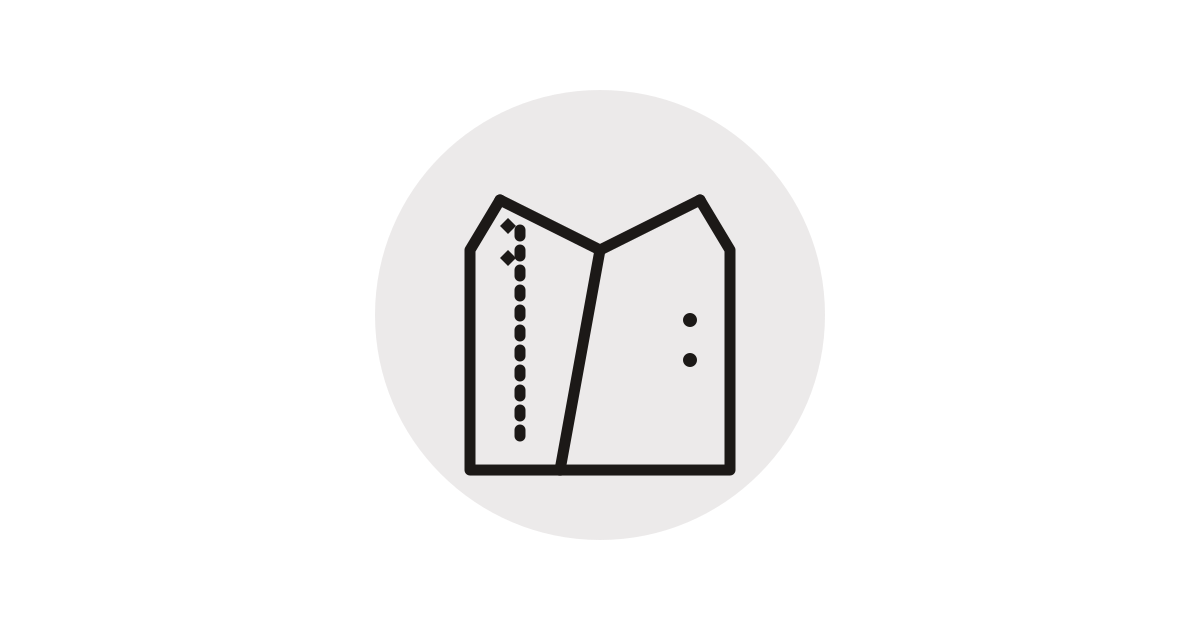
Irving Schott designed the Perfecto in 1928 as a response to the motorcycle culture emerging in America. The asymmetrical front zipper (instead of a center zip, which is more common in other jackets) gives the jacket its distinctive look and, more importantly, allows riders to zip and unzip the jacket while sitting on a motorcycle without dismounting.
The name "Perfecto" was Schott's assertion: this is the perfect motorcycle jacket.
What made it stick, what made it iconic, was not just the silhouette. It was the material decision: Schott chose to use heavy steerhide (cowhide from steers, thicker and more durable than horsehide) and later refined the construction with quilted lining, Talon zippers (a premium brand), and studs on the shoulders (the 613's stars, or simple snaps on the 618).
Then, crucially, Schott did not change it. While other jacket makers updated their designs every five years, Schott made the Perfecto in 1928, refined it slightly over the next decade, and then locked the design. Seventy years later, it looked essentially the same.
Why That Doesn't Matter for Cultural Impact (But Does for Collectibility)
Marlon Brando in The Wild One (1953), James Dean (though James Dean wore other jackets, the Perfecto became his association), Punk rockers in the 1970s, and countless motorcycle clubs all chose the Schott Perfecto not because it was new, but because it was old. It was a classic when they found it.
That cultural weight, accumulated across decades, is what makes a 1950s Schott Perfecto worth three to four times what an identical-looking 1990s licensed reproduction costs today.
Dating a Schott Perfecto: Five Key Details
Zipper brand - Talon zippers (the brand name stamped on the slider) appear in pre-1960s examples. Later reproductions often use generic zippers. Original Talon hardware commands a premium.
Label style and position - Early labels (1940s-1950s) are small, printed directly on the leather or lining. Labels gradually enlarged and became more centered. A tiny, worn label in a spot that no longer appears on modern jackets dates the jacket reliably.
Lining material - Earlier Perfecto jackets used heavier quilted cotton lining, often with visible stitching. Modern reproductions use thinner, sometimes synthetic lining. The heft of the lining under your hand is a quick authenticity check.
Pocket snap style - Early examples used simple metal snaps; later models sometimes featured branded snaps with the Schott name or S-logo. Snap style changes correspond to production eras.
Country of origin tag - Pre-1970s Schott jackets say "Made in USA" or "Made in Brooklyn, NY." Post-1970s moved offshore. A "Made in USA" tag on an otherwise worn jacket is a strong collector signal.
Combining all five details gives you a reliable date window within 10-15 years. A 1955 Perfecto 613 with original Talon zipper, small USA label, heavy quilted lining, and simple snaps is unmistakably authentic to that era.
The Price Architecture for Vintage Schott
| Era | Condition | Typical resale price | Key details |
|---|---|---|---|
| 1940s-1950s | Excellent | $800-$1,200+ | Original Talon zipper, heavy steerhide, USA-made label, minimal hardware changes |
| 1950s-1960s | Good-Excellent | $600-$900 | Talon zipper, good steerhide, minor wear, USA-made |
| 1960s-1970s | Good | $300-$600 | May have mixed-era hardware, visible wear, USA-made |
| 1970s-1980s | Very good | $200-$500 | Newer era but still pre-overseas, some hardware updates |
| 1990s licensed repro | Excellent | $150-$300 | Post-factory shift, different zipper, synthetic lining visible |
| Modern (2010+) | New/excellent | $600-$800 | Overseas production, modern construction, new not vintage |
Notice the 1990s licensed reproductions command less than half the price of authentic 1960s-1970s originals in similar condition. The lost original hardware and the factory change (moved offshore) drive the discount.
What Buyers Are Actually Looking For
Collectors prioritize:
- USA manufacture - Almost non-negotiable for prices above $500
- Original zippers - Talon is the gold standard; any other brand is a minus
- Leather quality and preservation - Steerhide that has aged to a deep patina, without serious cracks or rot
- Completeness - Original snaps, functional pockets, stars intact on a 613
A jacket that ticks all four boxes can command $1,000+. A jacket that misses one drops to $400-$600 territory fast.
Finding and Pricing an Authentic Schott
Vintage Schott Perfecto jackets appear scattered across eBay, Depop, and specialty vintage shops. Prices vary wildly depending on the seller's knowledge. A knowledgeable collector may price a 1955 613 at $1,100. A seller who doesn't know the difference between a 1955 original and a 1980s remake may list it at $400, not realizing what they have.
Cross-searching the same jacket across multiple platforms reveals these price gaps. Crawli lets you see identical or near-identical Schott jackets listed on eBay, Depop, Poshmark, and Vestiaire simultaneously, so you can spot when one platform is offering a historic deal or when a seller is uninformed. That cross-platform transparency is how you find the steals on vintage Schott, look for the listings on smaller platforms (Depop, Etsy) where they might be underpriced compared to specialty vintage retailers.
When you spot a Schott Perfecto jacket, check the label, zipper brand, and lining quality. Then search for the same jacket across all platforms at once. The more you see the range of pricing, the easier it is to recognize when you've found the real deal at the right price. For the broader test of whether any leather jacket, Schott or otherwise, is full-grain quality worth this kind of premium, see our guide to identifying quality vintage leather. Search free at thecrawli.com.